
Last updated on November 14th, 2025 at 04:26 pm
Understanding What You’ll Really Pay for a Complete Home Renovation
How much does it cost to renovate a house? If you’re planning a home renovation in the Boston area, expect to spend between $19,500 and $88,400 for most projects. The national average is $52,275 for a standard-sized home, but your actual costs will depend on the scope of work, materials, and your home’s condition.
Quick Cost Overview:
| Renovation Type | Cost Per Square Foot | Total Project Range |
|---|---|---|
| Basic Updates | $15 – $60 | $19,500 – $88,400 |
| Mid-Range Remodel | $60 – $100 | $50,000 – $150,000 |
| High-End/Luxury | $500 – $1000+ | $250,000 – $500,000+ |
| Full Gut Renovation | $60 – $150 | $90,000 – $300,000 |
Home renovation costs have surged in recent years. According to the 2024 U.S. Houzz & Home Study, the median spend for homeowners has increased up to 60% since 2020, making careful budgeting more critical than ever.
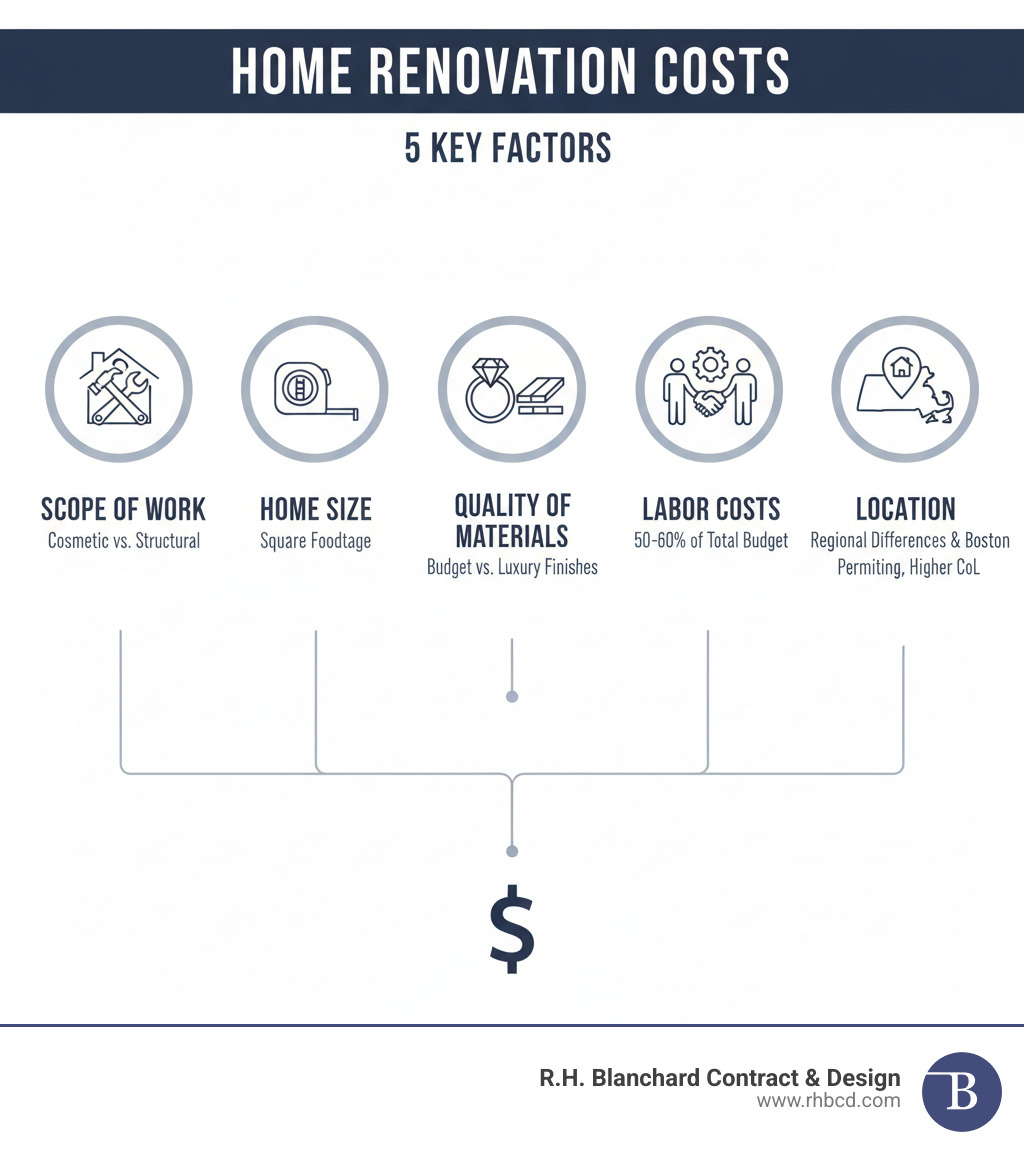
The final bill is impacted by the scope of your renovations, home size, material quality, and property condition. Labor alone often accounts for 50% to 60% of total expenses. In the Boston metro area, costs tend to run higher than the national average due to higher labor rates, complex permitting, and the prevalence of older homes needing extensive updates.
This guide breaks down everything you need to know about home renovation costs—from room-by-room estimates to hidden expenses. Understanding these costs upfront helps you budget realistically and avoid surprise overruns.
Key Factors That Determine Your Final Renovation Bill
When someone asks how much it costs to renovate a house, the answer is never simple. The final cost depends on several key drivers you can control.
- Project Scope: A cosmetic refresh (paint, new fixtures) is far less expensive than a structural overhaul that involves moving walls or adding square footage.
- Material Quality: The choice between laminate and marble countertops, or builder-grade versus custom cabinets, can double or triple your material budget.
- Labor Costs: Typically 50% to 60% of your total budget, labor rates vary by project complexity and location. Skilled labor in the Boston area commands higher rates, reflecting a higher cost of living and level of expertise.
- Home Size: Renovating a 1,200-square-foot home will naturally cost less than a 3,000-square-foot property.
For a comprehensive look at planning, our Guide to Renovating Your Home walks you through the entire process.

How the Age and Condition of Your Home Affects Price
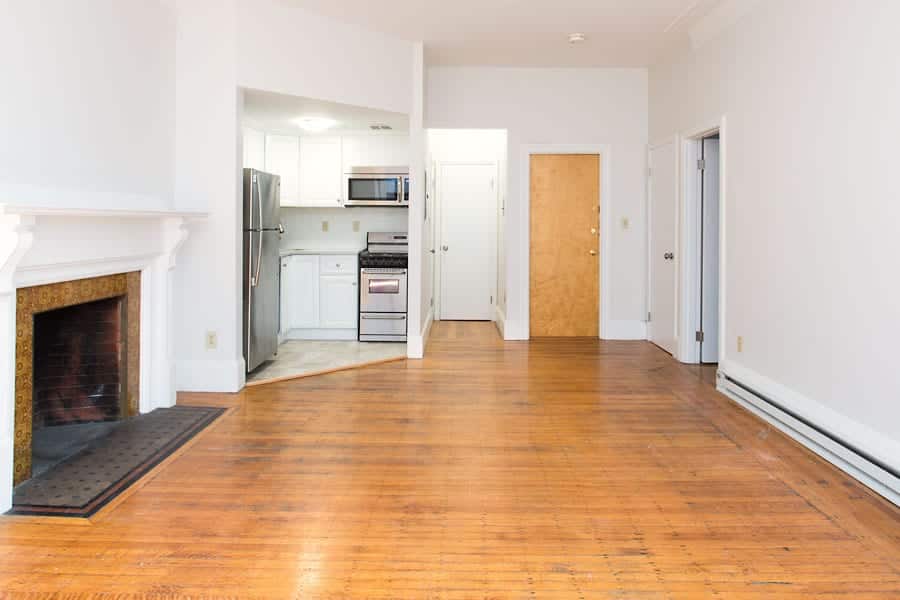
In the Boston area, older homes are common, and their charm often comes with hidden costs. If your home was built before 1980, be prepared for potential surprises that impact how much it costs to renovate a house.
- Electrical Upgrades: Old knob-and-tube wiring or outdated panels are safety hazards. Rewiring can range from $1,500 to over $10,000 for a whole home.
- Plumbing Systems: Corroded galvanized pipes or lead service lines may need replacement, costing anywhere from $350 to $2,000+.
- Hazardous Materials: Asbestos and lead paint are common in older homes. Professional remediation is required by law and costs $1,200 to $3,100 for asbestos and varies for lead paint.
- Foundation Issues: Settling, cracks, or moisture problems must be addressed before other work begins. Repairs typically run between $2,200 and $7,700.
Due to these potential issues, renovations for older homes often start around $100,000. For more on navigating these challenges, see our insights on Old House Renovation: Property Focus and Property Focus: Victorian House Renovation.
Regional Cost Differences: Why Boston Renovations Stand Out
Boston-area renovations consistently cost more than the national average due to several local factors:
- Higher Labor Rates: The region’s high cost of living translates to higher wages for skilled tradespeople.
- Complex Permitting: Boston and surrounding towns like Andover and Cambridge have strict building codes and a more involved permitting process, with fees from $500 to $2,500 for major projects.
- Logistics: Delivering materials to tight urban lots is more complex and can add to the bottom line.
- Age of Housing Stock: Boston’s historic homes often require more specialized labor and surprise repairs, increasing overall costs.
Understanding these regional realities is key to accurate budgeting. Learn more about the Pros and Cons of Home Remodeling in Boston.
Renovation vs. Remodeling: Understanding the Difference
Though often used interchangeably, these terms describe different projects with different costs.
- Renovation means restoring or refreshing what’s already there without changing the layout. This includes painting, refinishing floors, or replacing fixtures. It is generally less expensive.
- Remodeling means changing the structure or purpose of a space. This involves moving walls, relocating plumbing, or adding square footage. It is more complex and costly.
For example, updating a bathroom with new tile and fixtures (a renovation) might cost $12,000. Reconfiguring the layout and moving plumbing (a remodel) could easily cost $30,000 or more. For a deeper dive, see our expert insights on the Distinctions Between Restoration, Renovation, Rehab, and Construction.
How Much Does It Cost to Renovate a House? A Detailed Breakdown
Now that we understand the driving factors, let’s talk numbers. When homeowners ask how much it costs to renovate a house, we break it down by project scope and by room.
Here are typical cost ranges for popular projects:
| Project Type | Low-End (Basic) | Mid-Range (Standard) | High-End (Luxury) |
|---|---|---|---|
| Kitchen Renovation | $10,000 – $25,000 | $25,000 – $50,000 | $50,000 – $100,000+ |
| Bathroom Renovation | $5,000 – $10,000 | $10,000 – $20,000 | $20,000 – $50,000 |
| Basement Finishing | $20,000 – $40,000 | $40,000 – $60,000 | $60,000 – $75,000+ |
These ranges are a starting point, with final costs depending on your specific material choices and design complexity.
Cost to Renovate a House Per Square Foot
While a helpful metric, per-square-foot costs vary widely by room. A bathroom with complex plumbing will always cost more per square foot than a bedroom.
- Standard Renovation: For cosmetic updates like paint, flooring, and fixtures, expect to pay $15 to $60 per square foot.
- High-End Renovation: For premium materials, custom work, and structural changes, costs climb to $100 to $250 per square foot or more.
- Gut Renovation: Stripping a home to the studs and replacing all systems and finishes typically runs $60 to $150 per square foot.
Average Costs for Specific Room Renovations
Here’s a room-by-room breakdown of what you can expect to invest.
Kitchens: A mid-range kitchen renovation typically costs $14,600 to $41,500, including new semi-custom cabinets, quartz or granite countertops, and modern appliances. An upscale kitchen with custom cabinetry, high-end appliances, and structural changes can cost $79,982 to $158,530 or more in the Boston area. Our guide on Where to Start When Remodeling a Kitchen can help you plan.
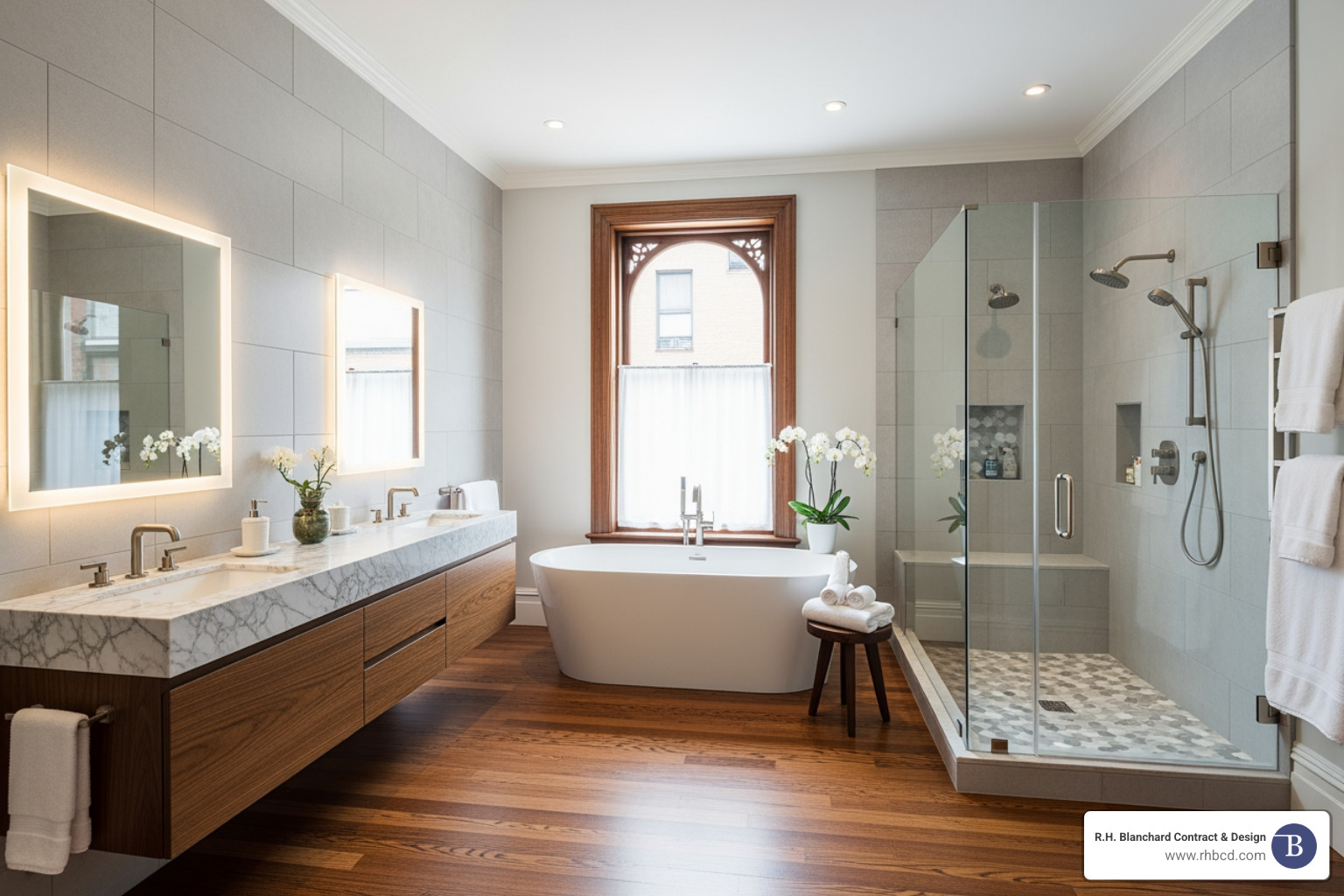
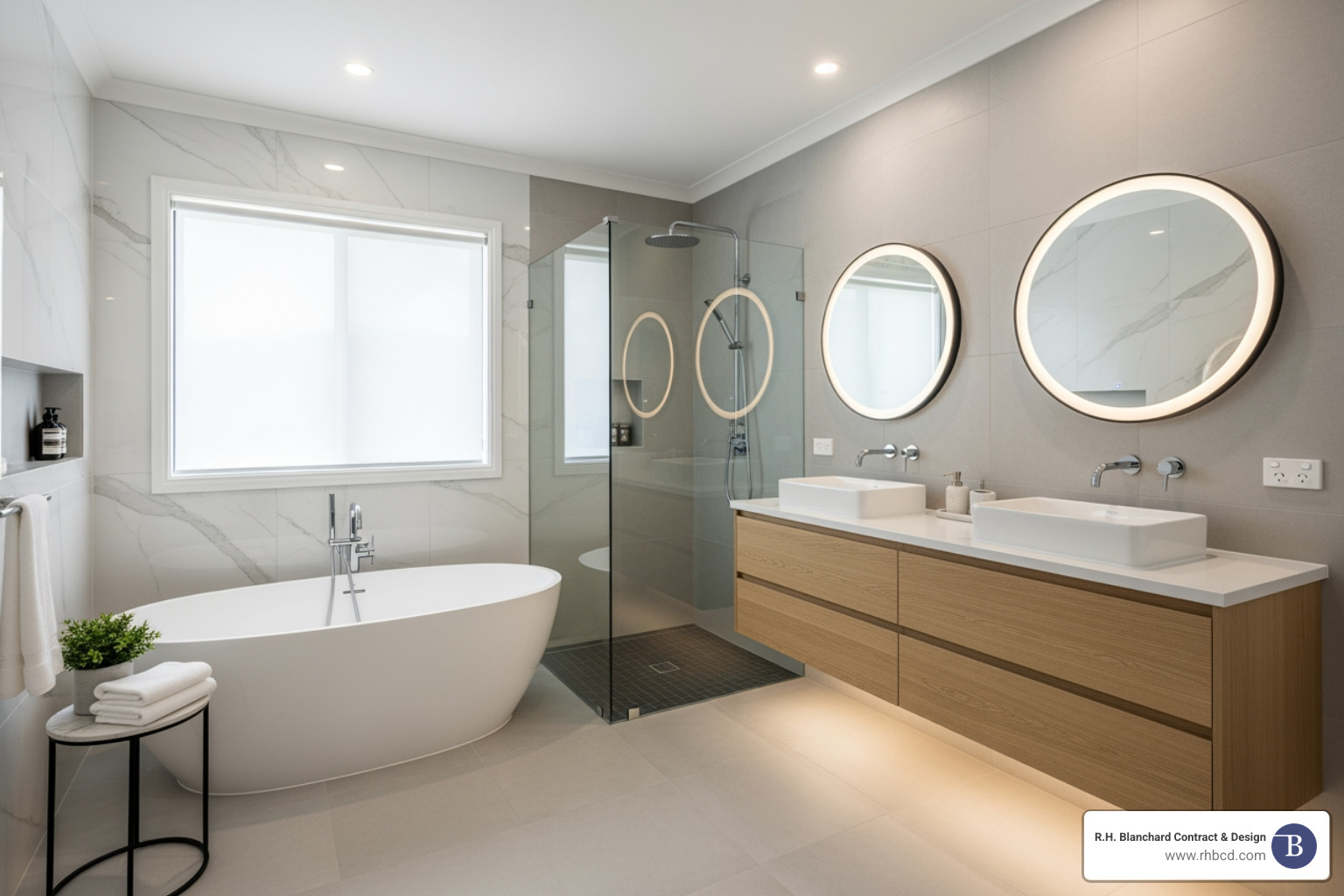
Bathrooms: A mid-range bathroom renovation to replace fixtures, vanity, and tile generally falls between $6,600 and $17,600. An upscale bathroom with luxury features like a walk-in shower, freestanding tub, or heated floors averages $25,251 or more, with some projects reaching $78,840. Learn more about How Much Does a Bathroom Remodel Cost?.
Basements: Finishing a basement to add living space typically costs $20,000 to $75,000. The price increases with additions like a bathroom or wet bar. This project offers excellent value by adding square footage at a lower cost than an addition. See the 5 Advantages of Basement Renovation Costs.
Bedrooms: As they lack plumbing, bedrooms are more budget-friendly, ranging from $4,000 to $40,000. Simple updates like paint and flooring cost $1,500 to $5,500, while high-end projects may include custom built-ins or creating a primary suite.
Exteriors: These projects boost curb appeal and protect your home. Siding replacement averages $5,572 to $17,603. Roof replacement typically falls between $5,855 and $13,116. A new deck can range from $4,100 to $11,700. We explore this topic in Interior vs. Exterior Home Renovations.
Beyond the Obvious: Additional & Hidden Renovation Costs
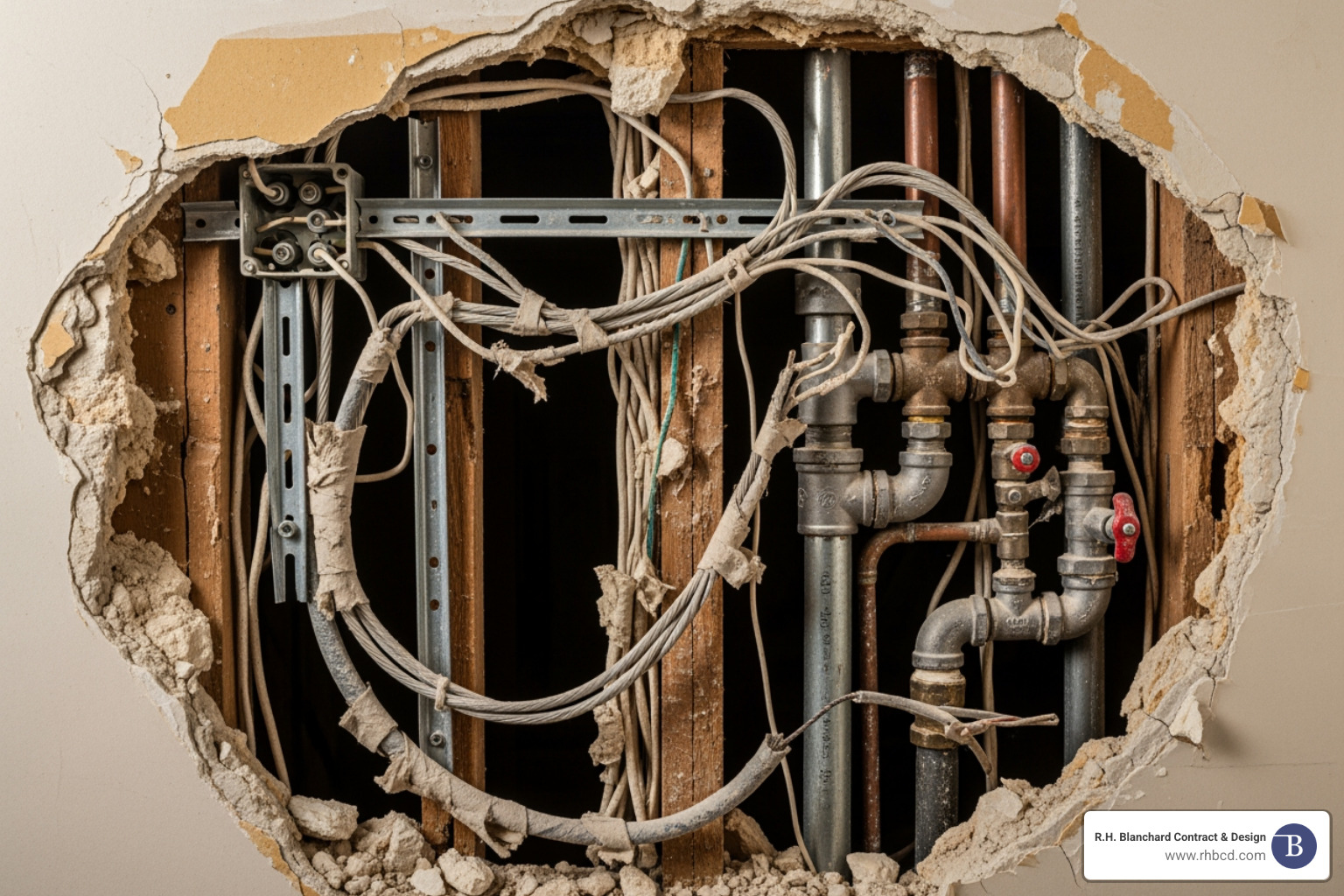
Your initial estimate is rarely the final number. Nearly every renovation, especially in older homes, uncovers unexpected issues. This is why we strongly recommend a contingency fund of 10-20% of your total project cost.
This fund acts as a safety net for surprises, ensuring you can address them without derailing your budget or timeline. If you have a $50,000 kitchen budget, set aside an extra $5,000 to $10,000. If you don’t need it, great. If you do, you’ll be prepared.
Common Additional Expenses to Budget For
Even without surprises, some necessary costs are often overlooked in initial budgeting:
- Permit Fees: Required for most renovations in the Boston area, these typically run $500 to $2,500 and ensure work is done to code.
- Architectural/Design Fees: For projects with structural changes, expect to pay 10-15% of the project cost for professional plans.
- Debris Removal: Dumpster rentals and disposal services are necessary to haul away construction waste.
- Temporary Housing: For extensive renovations, you may need to budget $2,000 to $10,000+ for alternative living arrangements.
The Biggest Hidden Costs to Be Aware Of
These are the issues you can’t plan for until demolition begins, making a contingency fund essential.
- Structural Issues: Rotting wood, compromised beams, or foundation problems are safety issues that must be fixed. Foundation repairs alone can cost $2,200 to $7,700.
- Outdated Systems: In older Boston homes, finding knob-and-tube wiring or corroded galvanized pipes is common. Upgrading these systems is critical for safety and can cost thousands. See our guide on 4 Home Electrical Improvements You Need to Invest In.
- Hazardous Materials: If mold or asbestos is finded, professional remediation is required for health and safety. This can cost $1,200 to $3,100+.
- Pest Damage: Termites or other pests can cause hidden structural damage that must be repaired after extermination.
Smart Strategies: Financing, Saving Money, and Maximizing ROI
Understanding how much it costs to renovate a house is the first step. The next is making smart financial decisions to maximize your investment and your enjoyment of the final result. A renovation is an investment in both your property’s value and your quality of life. Our insights on Boston Home Renovations Worth the Investment explore this balance.
Does Renovating a Home Increase Its Value?
Yes, most renovations increase home value. While you may not recoup 100% of the cost, strategic projects offer a solid return on investment (ROI). On average, homeowners can expect an ROI of around 60%.
- Kitchen and Bathroom Renovations are top performers, typically yielding 50-80% ROI. Buyers prioritize these spaces, making them a major selling point.
- Exterior Improvements like new siding (70-80% ROI) or a new roof (60-70% ROI) significantly boost curb appeal and offer impressive returns.
Some projects, like a finished basement, are worth it for the lifestyle improvement they provide, even if the financial ROI is lower. Learn more about 6 Home Improvements That Build Equity.
Best Ways to Save Money on Your Renovation
There are proven strategies to keep your project on budget without sacrificing quality.
- DIY Smartly: Handle simple tasks like painting or demolition yourself, but always hire licensed professionals for electrical, plumbing, and structural work. For guidance, see Home Renovation Projects: To DIY or Not to DIY?.
- Phase Your Project: If a large-scale renovation isn’t feasible at once, tackle it in phases (e.g., kitchen first, then bathrooms). This helps with cash flow, though the total cost may be slightly higher over time.
- Choose Mid-Range Materials: High-quality mid-range options like quartz countertops can provide a luxury look for a fraction of the price.
- Install Energy-Efficient Upgrades: Items like new windows and insulation may cost more upfront but save money on utility bills. The Inflation Reduction Act offers up to $3,200 annually in tax credits for these improvements. Explore 5 Energy-Efficient Home Improvements for ideas.
- Get Multiple Quotes: Obtain at least three detailed quotes and compare the scope of work, not just the final price.

How to Finance Your Home Renovation
You have several options to pay for your project:
- Cash Savings: The most direct method, avoiding interest and debt. Be sure not to deplete your emergency fund.
- Home Equity Loan or HELOC: These use your home’s equity to secure a loan, often at a lower interest rate. A home equity loan provides a lump sum, while a HELOC is a revolving line of credit.
- Personal Loan: An unsecured loan with a fixed rate and term. Interest rates are typically higher than for equity-based loans.
- Cash-Out Refinance: Replaces your current mortgage with a new, larger one, giving you the difference in cash. This makes sense if you can secure a lower interest rate.
To explore which option is best for you, you can Get started with a mortgage lender to review your options.
Frequently Asked Questions about Home Renovation Costs
Here are answers to the most common questions we hear from homeowners trying to budget for a renovation.
Is it cheaper to renovate or build a new house?
In most cases, renovating is cheaper. You’re starting with an existing foundation, structure, and utility connections, which saves tens of thousands of dollars. Building new only becomes a consideration if a home has extreme structural failures, widespread rot, or hazardous materials that make repairs prohibitively expensive. A thorough inspection is key to making the right choice.
How much does it cost to renovate a house by hiring a general contractor?
A general contractor’s fee is typically 10% to 20% of the total project cost. For that fee, they manage the entire project: hiring and scheduling all tradespeople (plumbers, electricians, etc.), securing permits, passing inspections, and solving problems. For most homeowners, a GC saves significant time, stress, and money by preventing costly errors and delays. The value they provide in expertise and peace of mind is often well worth the cost. Learn more in our article, Do I Need a General Contractor to Renovate?.
How much does it cost to renovate a house in phases versus all at once?
Both approaches have pros and cons.
- Renovating all at once is generally more cost-effective and faster. You benefit from bulk material discounts and avoid the repeated costs and disruptions of starting and stopping work. The project is finished sooner, and the design is more cohesive.
- Phasing your renovation is a good strategy for managing cash flow. By tackling one room at a time, you can pay as you go without taking on a large loan. The trade-offs are a longer overall timeline with ongoing disruption and potentially a higher total cost in the long run.
Our guide on the Timeline of a Construction Project: Design-Build can help you understand what either approach involves.
Your Boston Home Renovation Partner
So, how much does it cost to renovate a house? The answer depends on your vision, your home’s condition, and the unique factors of renovating in the Greater Boston Area. Costs can range from a $19,500 refresh to a $300,000+ gut renovation, which is why expert planning is essential.
Boston’s beautiful older homes often hide surprises like outdated wiring or plumbing. A transparent, detailed plan is your best protection against budget overruns.
For over a decade, R.H. Blanchard has helped Boston-area homeowners steer these complexities. As a family-owned general contractor, we understand that a renovation is an investment in your family’s quality of life. Our comprehensive design-build services provide a one-stop solution, ensuring precision and transparency from the first conversation to the final walkthrough.
We know the Boston permitting process and the challenges of our region’s housing stock. Whether you’re dreaming of a new kitchen, an updated bathroom, or a whole-house renovation, we have the local expertise to bring your vision to life.
Ready to turn your ideas into reality? Let’s discuss your project and budget. Explore our remodeling services and start planning your project today.